What it took
A calendar is the most impersonal record of a life I can think of, and the most specific. It knows exactly when I was in a room, for how long, and with how many people. It knows nothing else. It does not know that the 7 am call was terrifying, that a night was three and a half hours of sleep, that a block labelled "Family time" was the most important entry of its year. Everything becomes the same flat rectangle. No ups, no downs, no doubt, no struggle, no joy.
So I took eleven years of mine, 31,339 events from June 2015 to today, and read them back like a diary I never meant to keep. Then I put the feelings back by hand, one chapter at a time: what the data shows, and what it took.
I was younger when I arrived at Elastic. Not just in years. I knew less. I was certain about more. I had several lives here, each one feeling, at the time, like I was becoming someone different. Looking back through the data, the boundaries are much harder to see. There are no customer names in what follows and no colleague names: companies become industries, people become counts. The people are the point, and they are all in it.
1 · Out of my depth
Before the first meeting there was the interview. The last round was a panel of very senior presales engineers, all of them grilling what must have looked like a kid on deep and wide architecture questions. One of them has stayed with me ever since. An e-commerce site has a single iPhone left in stock. Two buyers order it at exactly the same time: one on Earth, one on the Moon. Who gets it, and what does the architecture look like? I was so stressed about getting it right that I did not realize there was no right answer. They were not testing what I knew. They were watching how I thought. Did I pause before answering? Would I say "I don't know" and show them where my knowledge ended? They wanted to see the gaps, because the gaps were what they would have to invest in.
I was employee number 207. I did not think much of it at the time. Today it is one of the numbers I am proudest of, because it says I was there early, when almost everything was still to be built.
My first meeting at Elastic was at 7 am on a Monday, in a hotel room in Mountain View. I had flown in from Paris for X-School, the onboarding week where every new hire gets taught by the executives themselves. The call was with a French bank, together with a product manager from the Bay Area, about an observability use case. I did not really know what observability was. I spent the hour trying to survive, writing down every word I did not know so I could look it up that night.
My job was presales: inspire the customer, sell them the technology. I was not ready to do either. In my previous life I had used Elastic in the company I founded, as the place where we collected analytics and built charts. Walking in, I discovered it was much more than that: a robust, widely used search engine, an observability solution being born, and more. The meetings did not wait for me to catch up. There was no time to block for learning, the demand was too high. So I studied every night, and every bit of downtime went into playing with the technology. The best curriculum turned out to be the day's meetings: every question a customer asked me that I could not answer became tomorrow's homework.
Onboarding ended with a certification, in front of a panel of the founding presales team, the people who were there before me. You prepared a presentation over weeks, put everything you had into it, and then faced questions that could be extremely hard. Most people failed the first time. So did I, one week before my wedding. It hit hard. I had worked so much for it, and part of me wanted to win and close that chapter before the big day. Instead, I put it away in my mind and lived my wedding fully. Then I came back to it, and passed.
Eleven years later that line reads 10,450 hours, more than five full working years spent with other people, on an invite or on the phone from the car. What strikes me is how straight it is. Roles changed, continents changed, a pandemic happened. The slope barely moved.
2 · My car was my office
People assume that working in France means meetings in central Paris. It mostly doesn't. The large enterprises and mid-market companies I worked with were spread around Paris and across the French regions, one to four hours' drive away. I never thought of that as a burden. I liked it. My car was my office, and the Paris office was my second office. A typical week was driving out to customers, a day trip by train or plane to another city, the same across Europe, sometimes a night in a hotel.
964 commute blocks, almost six hundred hours behind the wheel, nearly all of them between 2016 and 2018. That is fifteen working weeks on the road, and they were never empty. The car was where I took my one-on-ones, caught up with my team, and listened in on the calls I needed to follow without leading. The office just happened to be moving. So in this essay every one of those hours counts as meeting time.
These were the first go-to-market years for Elastic in Europe. There were meetups, advocacy, proofs of concept, first meetings with companies that had never heard of us. But also, very often, meetings with customers who were already running the technology in production and knew far more about it than I could have imagined. You learn humility quickly in those rooms. You also learn that the best thing you can bring is not an answer, it is a better question.
The trips are in the data too, if you know where to look. There were no booking confirmations in those years, just blocks I created by hand: "Traveling to Niort", "Travel to Lille", "Traveling to Toulouse". Read back, they add up to 62 train legs to customers across France and Europe, and more than thirty flights to Toulouse, Madrid, Barcelona and California. But one trip I would recognize anywhere. Our first Solutions Architect offsite, in Barcelona: just the founding team, together for the first time. We bonded deeply enough that we still talk about it. Somewhere between plates of jamón, the Jamon signal was born. It became an emoji, and for years it was how we said: this is important, look at this, celebrate this.
3 · Turning the spotlight
At some point you cannot be in every meeting yourself. I had to scale, which meant hiring people to do what I did, carving out territories, and stepping into presales leadership. I set the bar very high. My first hire came out of a customer meeting: one of the most brilliant sales engineers I had ever met, deeply passionate about technology, the kind of person I could trust with the customers I had spent years earning.
In 2017 I had 1,334 meetings and 436 forecast calls, more than eight a week. 2019 was the peak of hiring and scaling, and the year my calendar understates the most. I started with EMEA South, took on Central as well, grew a leader for Central and handed the region over to them. That year was onboarding, coaching, leadership meetings, and above all jumping into my team's calls to answer a question or unblock a deal. None of that shows up in my calendar. It was on theirs.
Moving into leadership taught me the most important lesson of those years. For a long time the spotlight had been on me. I had built a name and a credibility inside the company, and that visibility is probably what earned me the chance to lead. But once you lead a team, your job is to make that happen for the people around you. You cannot do it for them, they have to put in the effort. What you can do is build the environment where they thrive, individually and as a team, and then step out of the frame.
In October 2018, Elastic went public. I was one of about thirty of the most tenured employees invited to New York to be there when it happened. Standing there, the kid from the interview panel three years earlier, next to people who had built the company from its first lines of code, is a moment I will never forget.
The other thing that never shows up in a calendar is the nights. In 2017 I wrote a book on Kibana, and in 2019 another on machine learning. Each one started the same way as that first call in Mountain View: with something I did not fully understand yet, and the conviction that writing it down was the fastest way to learn it.
4 · Three and a half hours
The busiest month in eleven years is September 2020: 195 meetings, two thirds of them on video. That autumn I was handing over EMEA and taking over the Western US business directly, trying to understand a new team, its dynamics and its customers. Then travel closed. For a year I ran a California team from Paris.
My average night was three and a half hours. I would get to bed around one or two in the morning, French time, and my kids, who had no mercy, would wake me at half past six. I did not stop once to ask whether it was sustainable. I was too excited by the chance to help and to widen my impact. And I remain grateful that the company waited for me, when it could easily have hired someone local.
5 · The move
The move to California in April 2021 was a career decision and a family one. I had raised my hand for the US West role, and fought for it. My wife and I had wanted to live abroad for years. We wanted to do it before our first child, then before our second, then our third arrived. This opportunity was finally the moment.
In Paris, my day had two humps: a morning wave, a lunch gap, and a big peak at 4 pm when America woke up. In California the shape flattens into a plateau that starts at 6 am, because that is Europe's afternoon, and is mostly over by 5. The lunch gap disappears.
Family time appears in my calendar for the first time in 2020, and from then on it is one of the most frequent entries in the whole dataset. I learned it from my US team. My calendar was open to them and I saw them block time for their families right there, in plain sight, something I had rarely seen in Europe. After a year stuck in France, a move across the world, and a workload that kept pulling me away from home, I copied them. It was the only way to protect time for the people who are the reason I do all of this.
6 · A team that did not exist
Then I was asked to help with a problem. Customers were buying, but we were not good enough at helping them adopt what they bought, find value in it, and grow. The company needed someone who had built and led teams, and who knew what kind of people this would take. That is how Customer Engineering was born, and how I found myself in a global role almost overnight.
A new team means a new idea that nobody asked for yet. The Customer Architect role, focused on adoption and consumption, had to earn its place next to the Solutions Architects already embedded in every account team. So I went to every region, sat with local leaders and go-to-market teams, explained what we were trying to do and why it would help them, and met the customers where adoption mattered most. The flight count goes from ten or so a year in the Paris years to forty and more from 2022 on: 250 flights, 944,000 kilometers, more than twenty-three times around the Earth.
The rooms changed too. Banks, insurers and heavy industry dominated the European years. From 2020 on, software and cloud companies take a much bigger share, and in recent years the mix keeps spreading across more industries, which is what covering the whole world looks like.
The nights kept going. In 2023 I wrote a third book, on vector search, and started writing a patent on context for large language models. I was convinced that context was about to become the most important ingredient in how these models work, and that technology like Elasticsearch would become the layer that feeds it to them.
The part that does not show on a map is the clock. A global role from the US West Coast means your teams are mostly on the other side of the world. 963 meetings in my calendar started before 8 am: leadership calls, one-on-ones, complex topics straight out of bed. You cannot skip them if you want to know that things are on track. If a young engineer asked me what this kind of journey really takes, that would be my honest answer: not brilliance, but showing up at 6 am to talk to someone at the other end of the planet, again and again.
7 · The other side of the table
In my last year I did something I had wanted for a long time. I shared that I was interested in moving to product, and I was offered the chance to help on observability, as general manager. I think the company saw someone who could lead a team, who had been deeply involved in the product since the beginning, and who had the credibility to do both: run the business, and build the right product and technology vision for it.
I arrived with a lot of opinions. I had sold the product for ten years and given plenty of feedback on it. What I found was a team of very talented people doing their best with the direction they had been given, and a team that had suffered from that direction changing too often, without a solid vision behind it. So from day one I pushed us to think about where we should go. I already knew where I wanted to go. That is the easy part. The hard part is rallying everyone around it: the team, the leadership, the field. Everyone has an opinion on what we should do.
Our second leadership offsite was where it came into focus. We put on the table everything we were doing right and everything we were not. It was revealing about the gaps in the team, and it was a great exercise precisely because it was uncomfortable.
Then I had to go and advocate for the vision, everywhere. Between October 2025 and October 2026 I took 54 flights, 268,000 kilometers, more than six times around the Earth in a single year: to customers, to the field, to teams on the other side of the world.
The field sells three solutions, search, security and observability, and has no obligation to pick one over another. So the work was to create real excitement for what was coming, and to make sure people could talk about it well to their own customers. I kept doing it until my last day, because I believe the observability team is going to crush it like it never has at Elastic.
The job taught me what I could not have learned from the field. As a field person I had strong opinions about what the product needed. As a GM I met the part I could not see: prioritization, dependencies, trade-offs. And I learned that any strategy, once everyone has aligned on it, takes time to materialize, and that the only way to see the fruits is consistency.
On the team, what I hope I brought is a taste for innovation: making sure people who want to innovate are heard, without ending up building a new prototype every week and shipping nothing. And a vision that people can believe in. Believing is hard to get. But once a team believes, it can align on one strategy it feels it can win on.
8 · The right moment
When large language models became a thing, I saw an opportunity for Elastic, and I still do. But my mind started to wander past what I was selling every day. I went deep into agents, coding agents, models, building them myself. I also noticed something I had always half known about myself: I get anxious when I am comfortable, because comfort means I am not learning as fast as I should.
The GM year was the opposite of comfortable. It was a new role, with new challenges I had to learn to manage. The only constant was Elastic itself, which I am extremely comfortable with: the technology, the people, the organization, and a lot of accumulated credibility that might have helped me execute faster than anyone. I could have kept going, with a very talented team, and we would have built something great together.
So the decision to leave was never about the work stopping being worth it. It was about timing, and for the first time the timing felt right. The foundations are there. The momentum is there. I am confident the team will win with or without me, and I am not leaving behind anything that cannot be handed over or finished. Many people would say this is not the moment. For me it was the first moment I felt it was. So I made the hardest decision of this whole story: to step away from a senior executive role I had worked so hard to reach, and jump into something new, closer to the wave, with new things to learn and new people to meet.
9 · This is my station
What surprises me, reading it all back, is how little of what remains has to do with the things I thought were important at the time. Titles fade. Org charts disappear. Even some of the victories we fought hardest for are difficult to place on the timeline.
But people don't. Behind these charts are 4,570 colleagues who shared an invite with me, and 5,272 people from outside who gave me an hour of their day. None of them are named here, and every one of them is in it. While you are living it, everything feels permanent. There will always be another meeting, another problem to solve, another dinner, another flight. We say "see you tomorrow" and mean it. And then, somehow, the years are behind you.
Eleven years of meetings, commutes, trains and flights. Somewhere along the way, you recognize your stop. This is my station. Not because the journey stopped being beautiful, or meaningful, or worth believing in. Sometimes something can still be all of those things, and yet it is time to go.
Eleven years ago I stepped into the unknown with my wife and our daughter. This time there are four of them by my side, the people who made every one of these years worth it.
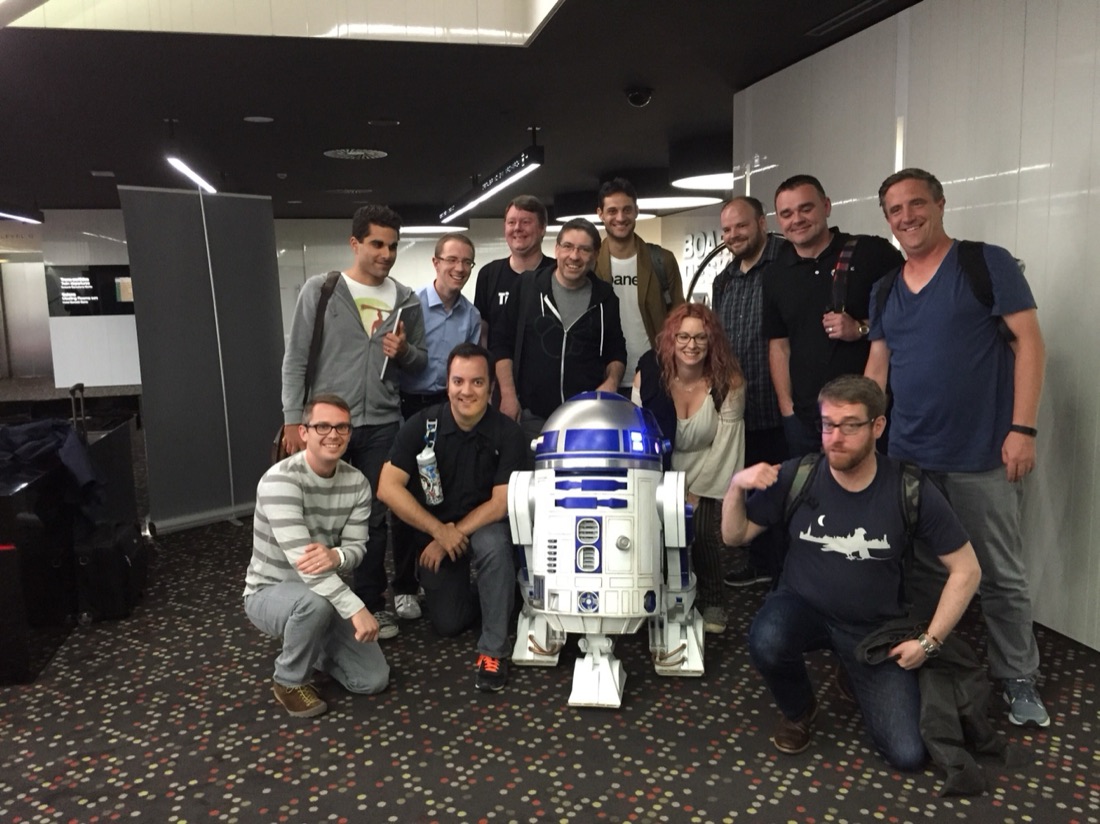
If there were ever a moment for the Jamon signal, it is this one.
I don't know exactly what lies ahead. Eleven years ago I didn't either. I would send a few words back to the person in that Mountain View hotel room, at 7 am on a Monday, writing down the words I didn't understand yet:
It's ok to feel lost. Expect nothing and appreciate everything. There will be difficult moments along the way, but the joy this journey will bring is beyond anything you could possibly imagine.